
Multidisciplinary engineering from concept to working hardware.
Our work can span research, mechanical design, electronics, embedded systems, software, prototyping and manufacturing support — bringing the disciplines needed for a project together around the same engineering problem.
The type of projects we are equipped to undertake.
New product development
Taking an initial idea, requirement or opportunity and developing it into a practical engineering solution.
- Typical scope
- Research and feasibility, concept development, system architecture, mechanical and electronic design, prototyping, testing and design refinement.
- Potential outcome
- A working prototype and the engineering information needed to progress towards manufacture or further development.

Engineering feasibility & technology assessment
Investigating a technical requirement before significant development expenditure is committed, giving the customer a clearer basis for deciding how — or whether — to proceed.
- Typical scope
- Requirements analysis, technical research, technology comparison, architecture options, constraints, risks, commercial considerations and recommended development routes.
- Potential outcome
- A structured research report or presentation that compares the available approaches, identifies key risks and recommends practical next steps.
Electromechanical systems and prototypes
Developing mechanical packaging, electronics, firmware and interfaces together where the product cannot sensibly be divided into isolated disciplines.
- Typical scope
- Enclosures, internal mechanical arrangements, PCB development, sensors, actuators, embedded control, communications and functional prototype builds.
- Potential outcome
- An integrated development unit that can be evaluated as a complete system.
Custom electronics and embedded systems
Electronic hardware and firmware for new products, specialist equipment, test systems or upgrades where off-the-shelf solutions are unsuitable.
- Typical scope
- Circuit design, PCB layout, embedded firmware, sensor interfaces, communications, power electronics, control and prototype verification.
- Potential outcome
- Prototype hardware, firmware and manufacturing data ready for integration or further qualification.
Manufacturing tooling and test systems
Purpose-designed equipment to make assembly, alignment, inspection and testing easier, faster or more repeatable.
- Typical scope
- Assembly jigs, alignment fixtures, holding tools, electrical test interfaces, test electronics, embedded control and operator aids.
- Potential outcome
- A practical production tool or test system designed around the product and the process that actually needs to be performed.
Existing product and legacy equipment development
Improving, modifying or replacing parts of an existing product or machine when the original solution is no longer suitable, available or economical.
- Typical scope
- Reverse engineering, obsolete component replacement, control-system redesign, mechanical modifications, additional functionality and prototype validation.
- Potential outcome
- An updated solution that extends the useful life or capability of existing equipment without starting again unnecessarily.
Engineering disciplines that can be brought together around the project.
Product & Mechanical
Research and development, concept design, 3D CAD, detailed mechanical design, enclosures, assemblies, design for manufacture and functional prototyping.
Electronics & Embedded
Circuit design, PCB development, embedded firmware, sensors, communications, control electronics, power electronics and hardware integration.
Software & Systems
Embedded software, engineering utilities, hardware interfaces, data acquisition, communications, IoT systems and supporting technical software.
Prototype, Test & Production
Functional prototypes, low-volume parts, assembly tooling, alignment fixtures, test equipment and practical production engineering support.
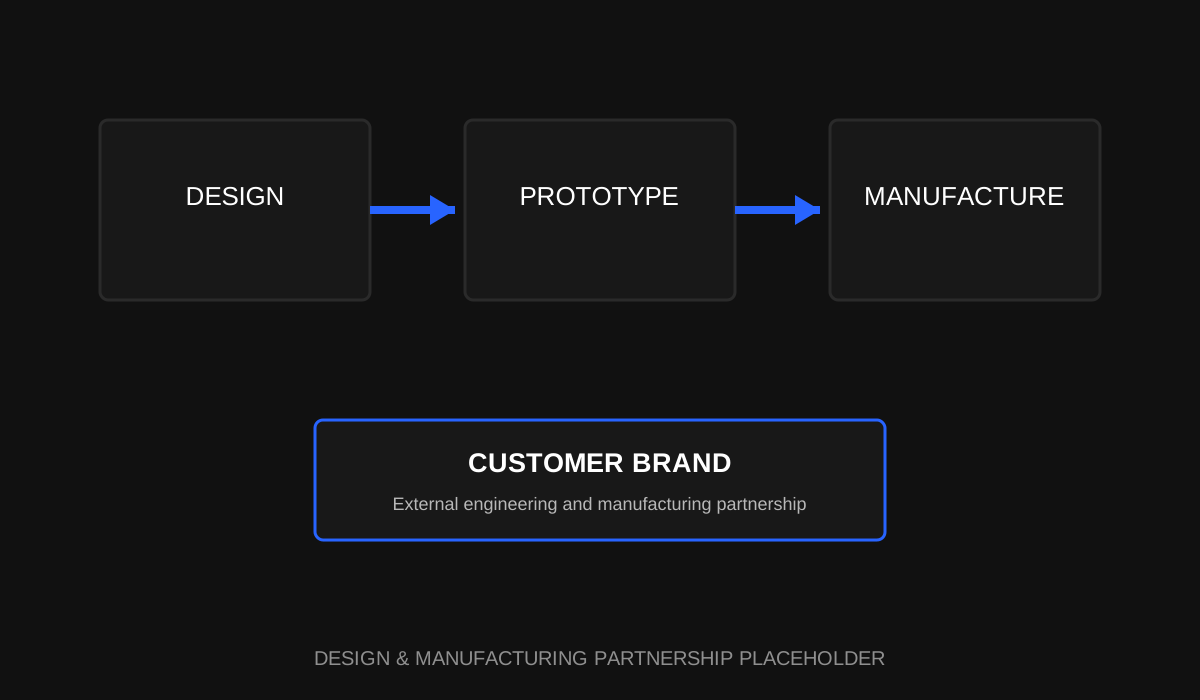
From external design resource to ongoing manufacturing partner.
Some customers need more than a design package. JIKU can act as an external engineering partner for products developed and sold under the customer's own brand, supporting the route from idea and engineering development through prototypes and production preparation.
Where appropriate, that relationship can continue into ongoing manufacture, assembly or supply rather than ending when the design files are handed over.
Broad technical experience behind the work.
Our team combines academic research and commercial engineering experience across a wide range of technical disciplines.
Academic and technical backgrounds within the team include a university professorship, a PhD in electronic systems engineering, and multiple higher education electronic engineering qualifications.
Electronic systems, embedded hardware, PCB development, power electronics and electrical engineering.
RF engineering, communications hardware, IoT sensors and connected networks.
Batteries, battery systems, power conversion and related control and monitoring.
Mechanical design, prototyping, multidisciplinary products and experience with machinery and large-scale manufacturing equipment.
Electrical and control design for automated systems ranging from small dedicated equipment through to large-scale manufacturing machinery.
Embedded development, engineering software, system integration, sensing, data acquisition and communications.
A practical route from requirement to result.
The exact process depends on the project, but development typically moves through the following stages.
Understand & investigate
Clarify the requirement, constraints and commercial objective, then research or test the areas that need proving first.
Design & develop
Develop the mechanical, electronic and software elements needed to turn the requirement into an engineered solution.
Prototype & test
Build and evaluate working hardware, identify issues early and refine the design using practical test results.
Refine, manufacture & support
Prepare the design and production information, support the transition into manufacture, or continue with ongoing manufacture and supply where appropriate.
ISO 9001 certified quality management system.
JIKU operates an ISO 9001 certified quality management system across the business, supporting controlled processes, review and continual improvement.
Certificate No. YOUR-CERTIFICATE-NUMBER
You can verify the validity of our ISO certificate by
entering your certificate number via this link:
certcheck.ukas.com
Have something you want to develop?
Whether it starts as an idea, an existing product or a difficult engineering problem, send us a brief description and we can discuss the most practical route forward.